Be wary of the games some electricity retailers play
Texas electricity shopping is a minefield of gimmicks and gotchas. The average household overpays by ~$400 annually, while savvy retailers keep inventing new ways to squeeze higher margins from their customers.
To help level the playing field, we list the most common gotchas to watch out for below. How many are you aware of?
Energy-only rates
Each month, you pay both your chosen Retailer for electricity and your local Utility to deliver it. All Retailers bill for delivery on your Utility’s behalf, yet some quote their energy-only costs (without delivery) to appear cheaper. Always compare quotes with delivery charges included. If they aren’t listed, move on.
Usage-dependent rates, credits, or charges
Sites like PowerToChoose condition shoppers to compare prices only at 500-, 1000-, or 2000 kWh/mo, despite their actual usage varying widely over the year. Retailers capitalize with rate gimmicks that appear cheap at those exact usages while charging more overall.
Example: A plan charges a flat $80 for the first 1000 kWh plus 15¢/kWh for usage over 1000 kWh.
That’s only 8 ¢/kWh if you use exactly 1000 kWh/mo. But it’s 10.3 ¢/kWh at 1500 kWh/mo, 11.5 ¢/kWh at 2000, and a whopping 16 ¢/kWh if you only use 500 kWh.
“Non-cumulative” rates
A more extreme version of the above, where using one kWh more can change the rate for your entire month’s usage.
Example: $80 for usage up to 1000 kWh, or 15¢/kWh for usage over 1000 kWh.
Using 1000 kWh costs $80, but using 1001 costs $150.15 (vs. $80.15 in the case above).
Partial billing cycles
If your plan has usage-dependent charges, mind your start date. Most plans count usage per pre-defined “billing cycles”. If you start on a mid-cycle day, you’ll get partial first- and last cycles, or 13 billing cycles for a 12-month plan. Depending on the plan, that can cost you more.
Example: You use ~1500 kWh/month and pick a plan that credits you $95 for using at least 1000 kWh/billing cycle.
If you start (and end) the plan in the middle of a cycle, your first and last [half] cycles will only include ~750 kWh usage and you’ll forfeit one $95 credit.
Free Nights and/or Weekends plans tease savings for consumers who shift their usage to off-peak hours. But inflated daytime rates lead most to pay higher average rates. The same goes for plans that bundle gift cards, thermostats, or other freebies. Always do the math.
100% renewable
Wind and solar energy have clear CO2 and pollution benefits, so many Retailers offer them exclusively or as an upsell option.
Unfortunately, the Renewable Energy Certificates (RECs) that underpin virtually all such plans in Texas are completely ineffective. A 100% renewable plan may cost you more, but it makes no difference in the transition to clean energy. Unless it’s your cheapest option, skip the “green” plan.
Wholesale rates
“Wholesale” plans can be good for certain off-peak users, but they’re not for everyone. Real-time rates are highly volatile, and summertime price spikes can quickly erode months of savings. These plans require focused effort and/or home automation to shift usage to lower-priced periods, and higher usage to offset their monthly membership costs.
“Free” plan advice
The psychology of “free” applies to where you shop, as well. All electricity shopping sites must earn money to cover their expenses. If you aren’t paying them to shop on your behalf, Retailers are paying them to sell you plans at higher rates. Guess which costs you more?
Name recognition
Advertising and high-profile sponsorships cost money. So it ‘s no surprise that the Retailers we’re most familiar with tend to charge higher rates for the exact same electricity. (It may be a surprise that those same companies also sell it under less-known sibling brands at a lower price.)
Non-yearly contracts
Summer month electricity costs Retailers extra, which they pass on to you. To appear cheaper, some offer plans that avoid or underweight summer, such as 6- or 18-month plans spanning October to March.
To compare plans of different lengths, always factor in estimated costs for any months they don’t have in common. More details.
Variable rates
With few exceptions, “variable rate” plans are expensive and unpredictable. Retailers can change pricing at their sole discretion, so rates tend to spike dramatically after the promotional billing cycle.
“Bait and switch”
Some Retailers post good deals on shopping sites, then tempt you with a barrage of seemingly cheaper rates when you visit their website to sign up. The new offers are usually of the usage-dependent type (see above) and more expensive, so stay the course to find your original target.
Non-recurring fees
Retailers’ Terms of Service documents detail one-time fees for non-payment, manual payment, disconnection, etc. You can avoid most of these with Autopay, e-billing, and timely payments; otherwise some can get quite expensive.
“Tease and squeeze”
Did you successfully navigate all of the above to nab a cheap rate? Retailers can still count on you forgetting your renewal months or years down the road. When you do, they’ll quietly roll you into an expensive month-to-month plan until you notice.
Win the Game
Knowledge is power, so we share these tips to help Texans get their best rate and save their hard-earned money.
For even more shopping power, click below to let our RateGrinder tool recommend the best plan for your home.
Not in the market for a new plan just yet? Tell our free RateAlert service about your current plan and we’ll monitor daily for better deals until your renewal.
Can you save money with Griddy’s wholesale electricity model? It depends…
February 2021 Update During Winter Storm Uri, Griddy customers incurred extremely high wholesale rates of ~900 ¢/kWh for days. Griddy subsequently filed for bankruptcy and is no longer serving customers. We’ll be updating this article with those details once the final data is available.
What Is Griddy?
Griddy offers a retail electricity plan indexed to the real-time wholesale (or “spot”) price, which updates every 5 minutes per supply and demand. Unlike traditional plans, Griddy does not guarantee a fixed rate over a contract term. Instead, they take a lower overhead approach where customers assume the pricing risks of full spot market exposure. Since there’s no guaranteed rate, there’s no contract term or early cancellation fees.
Griddy charges a $9.99/month membership fee, then passes through all other costs without markup for every 15-minute service interval. Service is prepaid similar to a toll road account. $49 opens your account, which recharges automatically from your debit or credit card when the balance drops to $25.
Griddy is a great option for some users, but it isn’t for everyone. Electricity spot markets are highly volatile, and most consumers don’t understand the risks and effort involved. Prices are low most of the time, but can quickly spike to levels that break household budgets. Just ask anyone on Griddy in August 2019 when the spot rate jumped from 3 ¢/kWh to 900 ¢/kWh for hours. Many who didn’t reduce their usage paid hundreds of dollars for a single day.
The tradeoff is one of reward vs. risk management. Whereas fixed-rate contracts insure the customer against rate changes, Griddy users are “self-insured”. And with self-insurance, you must have the financial means to absorb high prices, take actions to mitigate them, or both. But is the reward worth it?
Savings Claims
Griddy often touts savings versus the Texas average, but that’s a weak benchmark. The average Texan pays a woefully high 11.7 ¢/kWh, mainly due to expired or tricky plans. For those that neglect their utilities, Griddy may indeed save them money. But so would 10 minutes of shopping.
A better comparison is between Griddy and competitive fixed-rate plans. Griddy stakes a claim here, too, asserting that “Real-time rates beat fixed-rate plans every time.”1 They don’t, however, offer any supporting data. So we opted to do the math and sign up for Griddy to sample their service for ourselves.
For transparent comparison, we created the internet’s only Time-of-Use Plans spreadsheet calculator, posted here. Plug in your electricity usage history from SmartMeterTexas.com to compare your 12-month average Griddy rate to the best 12-month fixed rate available at the same start time. Since spot pricing is too volatile to forecast, the Griddy plot lags by 12 months. Comparing over 12 months is key, since electricity pricing varies by season.
Historical Performance
For an average usage, Griddy generally hasn’t beaten the best fixed rate plans. An exception was June 2018, when shortage fears drove fixed rates especially high.
Historical Griddy rates for the average Houston load
How can this be, if “every REP [Retail Electricity Provider] purchases their electricity from the same price, the real-time wholesale price”2, and Griddy uniquely “cuts out all the needless layers…to keep costs low”3? Some reasons:
REPs do buy “wholesale”, but not only on the volatile spot market. Other wholesale forward markets cover from one day to years in advance of delivery. To offer low fixed rates that also insulate customers from the spot market, “layers” of employees constantly shop to secure capacity at attractive prices.
Griddy’s $9.99/month membership fee adds ~0.7 ¢/kWh for the average home, or less for homes with higher usage.
Griddy downplays ‘Ancillary Services’ charges, which add 17 – 36% atop the spot price on the bills we’ve seen. Exact rates aren’t publicly disclosed, so our calculator assumes 20%.
Griddy passes through a 2.5%+25¢ fee for each credit or debit payment. To avoid credit checks and customer defaults, Griddy is prepaid only. But they don’t support free bank drafts like most REPs.
Price Spikes
Last but definitely not least is spot market volatility, aka “price spikes”. The spot market works like a real-time auction, balancing electricity supply vs. demand for every 5 minute interval. As supply gets tighter, prices go up. When it gets very tight, they go up a lot. Sometimes spikes follow predictable events like extreme weather. Other times, a generator or transmission line failure causes issues out of the blue.
The chart above shows the impact of August 2019 spot price spikes on an average Houston home. Two days at ~200 ¢/kWh — including four hours at 900 ¢/kWh — raised the 12-month average rate ~2.5 ¢/kWh, or ~$350/year.
Griddy notes that >$1/kWh spikes are less common than “negative” (<$0/kWh) pricing, which is true. But the magnitude of these spikes, multiplied by the higher usage that drives them, can do sizable damage to electric bills. And while negative energy prices are nice, they rarely go negative enough to offset the TDU delivery charges. So don’t expect to make money running your arc welder at 2:00 am.
Shift and Save
Getting the best price on Griddy requires using less electricity when prices are high. In Texas, that typically means hot summer afternoons from 2 PM to 6 PM when millions of air conditioners are running full blast. Occasionally it’s cold winter mornings from 6 AM to 8 AM. When prices spike, Griddy users are financially motivated to shed or defer as much discretionary load as possible. Air conditioners, heaters, dryers, ovens, electric vehicles, and pool pumps are the first priorities.
How much can you save? That depends on you. The typical Texas usage profile would have cost ~5.4 ¢/kWh plus delivery over 12 months. The key exception is the 12 months prior to August 2019, when the average spiked to ~8 ¢/kWh.
Griddy savings potential examples
But what if that same home had deferred 50% of their load whenever prices exceeded 10 ¢/kWh (~2% of the time)? Per the orange line, they’d normally have averaged ~4.8 ¢/kWh, or ~6 ¢/kWh leading up to August 2019. That’s good enough to beat the best fixed rates from Sept 2019 onward. Granted, 2020 didn’t have summer price spikes like 2019 due to COVID-19.
Finally, the pink line shows the incremental savings for a home that averages 2 MWh/month instead of 1. In that case, Griddy’s $9.99/month fee contributes 0.5 ¢/kWh less.
The ability to lower your costs by changing your consumption behavior is Griddy’s main benefit. With a fixed rate, your rate is based on the projected average behavior of all customers. Wholesale plans, however, reward individual efforts to defer usage when prices are high.
Non-Trivial Effort
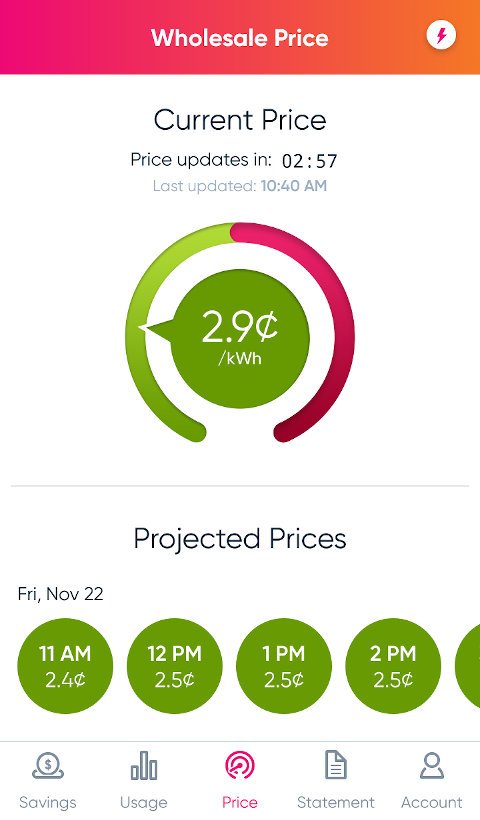
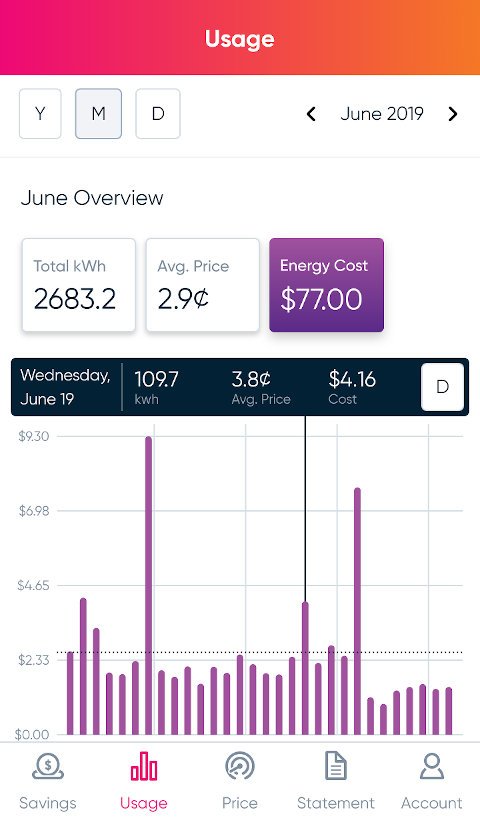
Shifting your usage takes effort, but Griddy provides tools to help, starting with an excellent app. On your phone or PC, Griddy shows real-time and projected spot prices through the next day. You can slice and dice your past usage, rates, and costs for any timeframe to easily see and learn from usage and price trends.
The app also alerts you to price spikes in real time, so you can you can turn devices off if you choose. The alerts work as intended, but they are not a long-term solution. Manually responding to repeated alerts disrupts daily activities. And when work or life prevent a timely response, alerts can be downright stressful.
Griddy wholesale price display
Griddy energy usage display
Automation
A more convenient and effective approach is to use home automation. As a first pass, nearly every load listed above can be scheduled with a programmable thermostat or timer to avoid the typical peak hours. This approach too has limits: Shutting off the AC for 4 hours every summer afternoon can impact family dynamics, to say the least.
For better results, Griddy enables event-driven control through IFTTT. IFTTT is a freemium service for implementing simple “If [This], Then [That]” rules. Griddy shares their spot price feed on IFTTT.com, and many appliance manufacturers allow IFTTT-based control. Between the two, users with an internet-connected smart thermostat can specify “If electricity prices exceed 10 ¢/kWh, then raise the AC setpoint 3°F”, or “If electricity prices return to normal, then resume the programmed schedule”. That way, loads are disabled only if/when prices actually spike, which is much less disruptive.
In practice, we experienced IFTTT reliability and response lag issues during the August ’19 price spikes, but Griddy says they’ve since worked with IFTTT to fix them. We also had to set the thermostat to pre-cool our home an extra 2°F from 11 AM to 4 PM so it would stay tolerable even if IFTTT disabled the AC for several hours. IFTTT supports numerous smart thermostat brands. They do not directly support any pool or EV charger brands, although some workarounds exist.
Greener Than Most
For clean energy supporters, Griddy is a compelling choice, but not for the reasons most people expect.
Unlike other retailers, Griddy doesn’t tout “100% renewable” energy backed by Renewable Energy Certificates (RECs), and that’s good.RECs don’t motivate new generation projects, they’re often overpriced, and they give consumers a false sense of accomplishment. Selling plans in Texas backed solely by REC purchases is essentially greenwashing.
Instead, Griddy educates consumers how they use electricity and financially motivates them to reduce or shift their usage. How is that “green”? As overall demand ramps up, grid operators tap resources from lowest to highest cost (and, as it happens, emissions): First wind and solar, then natural gas, and finally coal. Griddy’s price alerts often indicate expensive and dirty coal plants are ramping up to meet demand. But if enough consumers defer their load in response, those plants will stay offline, and the load will eventually be served by relatively cleaner natural gas plants instead. By changing their consumption behavior, Griddy users save money and incentivize a cleaner energy mix.
Of course, you could opt to behave the same way on a fixed rate plan, but would you? Like any insurance, fixed-rate plans decouple behavior from immediate consequences. Consumers feel free to consume, knowing someone else (the REP) is absorbing the impact of peak pricing. Not with Griddy: There’s nothing like a 200 ¢/kWh day to influence how and when you use energy!
Solar and battery storage owners may also benefit from Griddy. These technologies inherently reduce grid consumption during peak demand hours. And for excess generation in any 15-minute interval, Griddy credits customers at the spot rate for energy (but not TDU delivery). Whether Griddy offers the best payback for your system depends on a number of factors, so plug your data into our calculator or get a free, unbiased analysis.
Summary
Direct exposure to spot market prices is risky business. Griddy is leading efforts to bring it to the mainstream, but it’s not for everyone. Scoring low prices takes considerable effort to avoid price spikes, though some folks (like us) may enjoy the challenge.
At a minimum, anyone considering Griddy needs enough cash reserves to buffer highly volatile summer bills. Beyond that, actually saving money with Griddy depends on your circumstances.
If you chronically neglect your electric plan as your retailer ratchets your rate upwards of 12 ¢/kWh, then Griddy may cost you less. But that’s a very low bar that hopefully doesn’t apply to those who’ve read this far!
If you regularly shop your plan, Griddy might still save you money if…
Fixed rate offers are relatively high, and
Your usage is relatively high, to dilute Griddy’s $9.99/mo fee, and
You use home automation to reduce usage during price spikes, or
You have an inherently “off-peak ” electricity usage profile (e.g. rooftop solar, or multiple EVs charged overnight).
Everyone’s situation is different, and nobody can predict future spot market prices. Check out TPG’s Time-of-Use Plans Calculator to compare past Griddy performance for your home. Then click here to find your current best fixed rate.