Electricity Shopping Timing Tips

When is the Best Time to Shop for Cheap Electricity?
We hear this question a lot. If you’re out-of-contract and paying hefty month-to-month electricity rates, the answer is “right now”, because a contract rate will almost certainly cost less. If you diligently shop and renew your contract, the answer is “when rates are low”. More than a particular season, that depends on market trends and contract length, so read on to learn more.
Summer Electricity Costs More
Retail Electricity Providers (REPs) extend retail offers based on the wholesale prices they pay for electricity. In Texas, what they pay is mostly about natural gas and summertime.
Most of the time, electricity pricing follows the cost of natural gas, which is used to generate nearly half of all Texas electricity. Natural gas is abundant and consistently cheap. Barring extended cold weather in Northeastern states, gas-fired electricity typically costs less than 3 ¢/kWh.
In summer, however, millions of air conditioners ramp up electricity demand and prices significantly. As the total load exceeds the output of cheap wind, solar, and natural gas plants, grid operators must tap increasingly expensive sources like coal to meet the demand and prevent blackouts. On the hottest afternoons, this can temporarily drive wholesale prices as high as 500 ¢/kWh. For retailers, the July and August peak months mean buying twice as much electricity at two to five times the average cost – a double whammy.
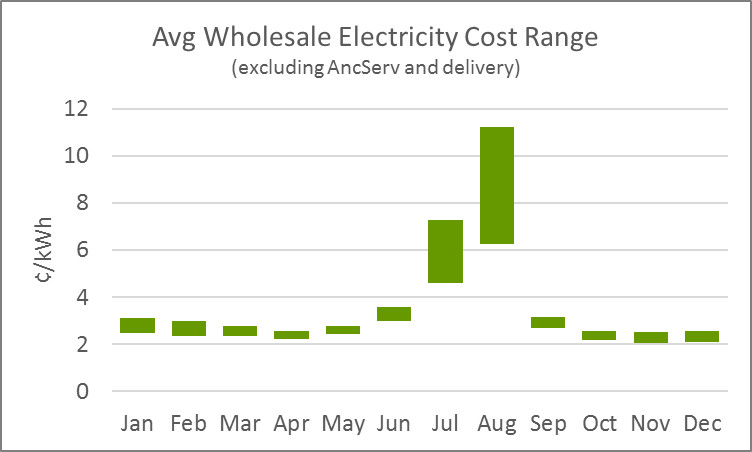
In turn, retailers pass on those costs as higher rates for plans that span summer. Based on cost forecasts for each month, they compute a volume-weighted average price for each plan. The tighter the expected summer supply — due to weather, new residents, plant retirements, etc. — the higher the price. And the shorter the plan, the more summer impacts the average rate. So in April a 6-month plan would generally carry a higher rate than a 12-month plan.
Part-Year Plans: Deal or No Deal?
Conversely, many Retailers seasonally trot out plans that avoid or underweight summers to appear cheaper. These include 3-, 6-, 9-, or 18-month plans beginning in September. Any of these tend to offer lower nominal rates than a 12-month plan, because they cover mostly off-peak months. But “lower” off-peak rates aren’t a better deal if they’re not low enough.
To compare plans of different lengths — especially peak vs. non-peak periods — you must include projected costs for any months they don’t have in common. (Texas Power Guide is the only site that does this automatically for DIY shoppers, based on the user-selectable ‘Max Term’ input.)
Apples vs. Oranges
If you bought NFL season tickets, would you prefer $100/game for the regular season, or $120/game including the Super Bowl? Texas summers are the Super Bowl of electricity. You can’t directly compare rates with vs. without them.
As an example: If 12-month rates are 5.1 ¢/kWh, a 6-month plan at 4.0 ¢/kWh may seem cheap. But if projected costs of the other 6 months raise the 12-month average to 6.1 ¢/kWh, that 6-month plan isn’t such a good deal.
Off-peak plans entice people to kick summer premiums down the road to their next plan; but unless you move you will pay them eventually. Off-peak plans also tend to expire in May or June as demand is increasing, which brings us to…
Full-Year Plan Seasonality?
12- and 24-month plans always have the same fraction of peak months, but is there any seasonal pattern to their rates? Some websites claim lower demand means better 12-month rates from December to March, but they don’t offer any supporting data. To test this theory, we tracked the lowest available rates for three years and plotted them below. (For the latest benchmarks customized for your ZIP Code and usage profile, click here.)

2017 did indeed exhibit a +0.6 ¢/kWh mid-year crest in 12-month rates. But 2018 and 2019 were dominated by price run-ups due to coal plant retirements (Jan-May ’18), natural gas shortage fears (Oct ’18), and tight summer ’19 capacity. More time might tell if there are truly seasonal patterns underlying those disruptions. But if you had blindly followed internet advice to buy in winter you would have paid 2019’s highest rates and missed both lows in August.
Buy Low, Monitor High
Timing the electricity market is more about one-off events than a particular season. Regardless of when your renewal comes due, check TPG’s Rate Trends chart to gauge the market and weigh your options.
If rates are low, are they low enough to lock in a plan longer than 12 months? Over the long term, rates are projected to decline slowly as renewables and natural gas continue to displace coal.
If rates are high, use TPG’s RateGrinder to find a shorter plan (3- to 12-months) and/or one with a low “early cancellation” fee. Then sign up for our free RateAlert service to get notifications if and when rates fall enough to justify another switch. By taking advantage of TPG’s tools you’ll ensure you always have the lowest possible energy bill.
Related Topics:
How to Shop For Electricity in Texas
How To Compare Texas Electric Plans